Tips
Building competitive digital services
What you need to either design and build a completely new digital service

All crises affect the competitive landscape, and when a recession looms society, businesses and individuals must adapt to the worsened economic situation. But there are ways to get through and perhaps even emerge stronger from a recession. Here are 7 tips to inspire you.
Our first tip is perhaps the most important but at the same time the hardest - you must mobilize your creative capital and be prepared to adapt. When your customers' priorities shift focus, as they often do in a recession, it's crucial to keep up and be proactive. The aim is to try to turn a crisis to your advantage by adapting to the new conditions and by "thinking outside the traditional box." Thinking outside the box may sound clichéd, but it couldn't be more relevant than when the competitive situation becomes tougher during a recession.

In good times you keep going out of old habit, but when things get worse you are forced to break out of old ruts. Perhaps that is also why new innovative ideas are born out of deep crises. Just look at all the restaurants (from budget to luxury) that during the pandemic were quickly forced to adapt their operations. When restaurant customers stayed away many began offering take-away or home delivery to keep their businesses afloat. Hotel rooms that then stood empty were offered as alternatives to home offices or as accommodation for healthcare staff.
A common thread in these examples is that people have had to act quickly, strategically and creatively to adapt to the prevailing circumstances, while also needing to be inventive and think in new ways
Sometimes it can be hard to get the thought process started. A useful method for solving complex problems, promoting innovation and sparking creativity is "Design Thinking". Broadly speaking it is about identifying problems by starting from the users and thereby finding and testing new ideas in order to learn from the experiences discovered along the way. If you're curious to learn more about the method you can read our article on Design Thinking.
Consider how your company can become more efficient and act differently. Can you adapt your operations for a period? Can you sell your products/services in new ways? Can you find new resellers, customer segments or new markets? Monitor the outside world and see what your competitors—who are probably in the same situation—are doing. Draw inspiration from companies in other industries and learn from their successes (or failures)

In an economic downturn many change the way they think, act and consume and it is easy to see problems rather than opportunities. Adapting to falling demand is not always easy. Sometimes both companies and consumers may simply need to hold back. But even if the downturn means you temporarily have to slow down and in various ways become more efficient and make savings, it can still be a wise idea to plan long term and dare to have a vision for the future
When we face challenges that we in one way or another must deal with here and now, while the outlook may be uncertain, long-term planning can of course be problematic since no one really knows what lies ahead. But many companies also have services and products that are well suited to a downturn
Several digital entertainment companies saw an upswing during the coronavirus pandemic when more people stayed at home. Companies that can or dare to invest should therefore consider investing in a downturn. For example, investment costs are often lower and the chance to gain market share is greater if your competitors choose to slow down
Think about which companies seem likely to withstand the downturn, what they do well and what you can emulate. Can you invest in or streamline something that allows you to adapt and think in new ways? Remember that investments made during a downturn can benefit you when the economy turns upward again
It may not always be about investing more, but about investing the right way. Digital investments can contribute to improvements in existing products, services and processes. Focusing on digital can make your company more agile and receptive to rapid changes, which is precisely what is often required in a downturn
By focusing on digital you can optimize conversion and work more effectively with brand communication.
Today we are increasingly online, we work remotely and new customer groups have adopted digital behaviour after the pandemic. The question is how well you meet the new customers' digital needs and expectations? Is there anything in your digital presence or in the digital customer journey that you can change, improve or simplify to support the increased digital behaviour or meet the needs of new customer groups?

Sometimes you can become a bit blind to your own environment and struggle to see things from your customers’ perspective — or even find the time to do so. Our best advice is to bring in experts who can help identify what can be improved and which investments will have the greatest impact. Sometimes small adjustments are enough, while in other cases a larger overhaul is needed. In the latter scenario, you can break the work into smaller deliverables. This allows you to make improvements step by step and integrate them into your long-term efforts. In our article How UX benefits your business, we explain more about how investing in user experience can create important competitive advantages.
In tougher times, more competitors fight for your customers’ attention. Loyal customers therefore become even more important during a recession. Hopefully, you’ve already been working on long-term customer relationships before the downturn hit. If not, now is the time to start. Identify which customers are profitable and with whom your company has — or can build — long-term relationships. Then make sure to maintain a closer dialogue about their needs. Perhaps your collaboration can grow, or the points of contact can be expanded?
Whether the economy is booming or slowing down, your customers want to know what your brand stands for and how your products or services solve their problems in the best possible way. In difficult times, however, customers become more risk-aware and are less willing to take chances. In some cases, they may even choose a more expensive product, service, or supplier if they recognize the brand and trust its reliability. Focusing on brand awareness, customer value, and solutions — rather than price — can therefore be a strong strategy.
Start with your offerings and consider which of these values become especially important to customers during a recession. Educate your customers about your products and services and highlight their benefits. See if you can clarify or adapt something in your offering to show how your solution helps reduce costs or increase revenue for your customers.
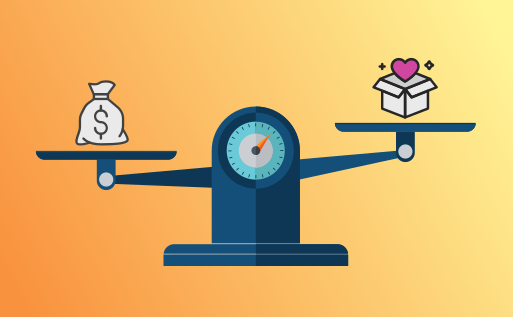
Price vs customer value - what is especially important to your customers in a recession?
During a recession, everyone in the company needs to take responsibility and contribute to the organisation’s resilience. Anyone who interacts with customers plays an important role in how the company is perceived and ultimately in influencing purchase decisions. Make sure your employees have the right tools and knowledge to talk about your brand and your products or services with confidence.
Transparency and honesty are also crucial in times of uncertainty and speculation. Be open about how the company is doing and what actions you are taking to manage the situation. By continuously involving and informing employees about the status and any measures being implemented, you can build a stronger sense of unity. In turn, this helps foster belief in the future and strengthens the feeling that together, we can get through the crisis.

There are, of course, no simple solutions to complex problems, but we hope we’ve been able to offer some inspiration and a sense of optimism in a time of uncertainty. If you need help reviewing your digital presence or want guidance on which digital initiatives could have the greatest impact for your business, we’re here to support you based on your specific needs and circumstances.