Technology
CI and CD
Continuous integration and continuous delivery play an important role in the development process. Here we tell you more.

As digital solutions become increasingly important for companies, users and society, the demands that services be stable and able to be updated quickly and without disruptions are also growing. This is where DevOps comes into play — but what is it and how does it work?
DevOps stands for development and operations and has its roots in agile development methods. The approach means that developers and operations engineers collaborate and apply shared principles to simplify and streamline the entire production and delivery flow. By using a range of DevOps methods and tools, you can build, test and continuously release in an automated pipeline more quickly and smoothly. This helps ensure that quality is maintained and that you can roll back to a previous version if an error is discovered after a release.

The purpose is to ensure that delivery is carried out as quickly as possible and with the best possible quality all the way to final delivery. Instead of being a leg in a relay race, where runners replace each other and pass the baton when they have run their part, all team members follow the product all the way to the finish. In short, you could say it is full lifecycle management of an application — a way to develop a product or service's software or systems in a more structured and collaborative way.
The DevOps methodology can be seen as a process or a lifecycle consisting of different phases. For each phase there are a number of tools and methods that help automate the flow to facilitate each step and move us forward in the process. For each phase there are a number of tools and methods. These help automate the flow to ease each step and move us forward in the process. The idea is to have loops as short as possible, and how long it takes depends on what you want to achieve and the conditions you have.
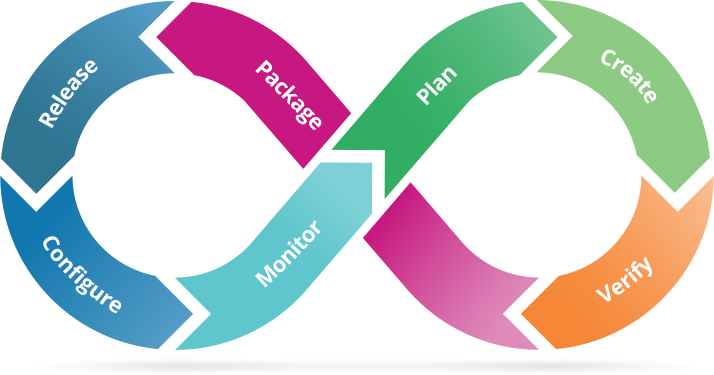
DevOps is largely about optimizing processes and automating workflows. It's also a way to meet changing market and user needs. To achieve this, teams use standard tools and methods that make it easier to collaborate and share information. Instead of doing their part and then handing it over to the next person in the flow, the whole team stays with the product all the way.
It's important that everyone in the chain understands how everything works. The key to good collaboration is therefore communication. If you succeed, the result is both better and more reliable deliveries. When you work as a team in a shared culture, you also have a greater ability to meet customers' needs and at the same time reach business goals faster. But this is also where one of the challenges lies. Promoting a DevOps culture can require some organizational changes, both in how people work and collaborate.
DevOps also promotes an experimental culture where you build, test and learn in order to continuously improve your methods and tools. Often this means spending a bit more time at the start of a project to set up the environments where everything will be built and tested. The benefit is being able to carry out faster release cycles and having the opportunity to test more extensively. This in turn serves as quality assurance. The organization can also gain better control over its delivery process and thereby has a greater ability to steer the business in the desired direction. Therefore, the most important thing is not that everything is done at once or perfect from the start. It's about starting somewhere and then working agile
Because features are released more continuously, much of the code is already tested and running in the correct production environment. This makes it easier to perform larger updates with fewer or no service interruptions as a result. For you as a customer, this means, in addition to fewer outages, higher-quality products and that new features can be launched often, continuously and faster.
CI and CD are part of the overall lifecycle and the DevOps process because they enable the automation of workflows. Where continuous integration ends, continuous delivery takes over, and both therefore play an important role in moving the process forward. If you want to know more about how the two systems work, you can read more in our article - What is CI and CD?.

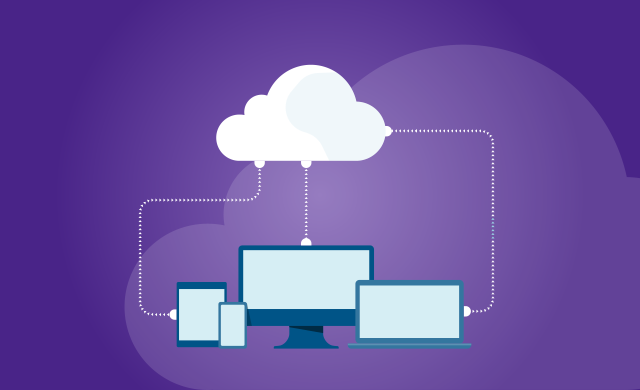
Methods and tools within DevOps are continually evolving and the demands that products and services be stable and able to be updated quickly without disruptions are increasing. As part of this, more information is being stored in various types of cloud services. By deploying an application via cloud services we have the opportunity to automate processes, which is what DevOps is about.
More specifically, a cloud means using multiple data centers located in several geographic locations around the world. All data handled and stored in cloud services is therefore physically stored in one or more data centers. When your users visit your website the information is retrieved from the data center closest to them, which makes it possible to load information faster. In other words, you benefit from storing information in multiple locations to provide users with the best possible response times and security.
As it has become increasingly common to store services and applications in the cloud, our users have also become accustomed to faster load times. If a web page takes too long to load we quickly give up and move on. The gains from cloud services are therefore substantial and in many cases have become business-critical. Of course, more access points can also mean more places to attempt intrusions. But with relatively simple measures it is possible to strengthen and streamline security, making the cloud less risky. One of the most common cloud platforms for automating and simplifying deployments is Microsoft Azure
Microsoft Azure is one of the industry-leading cloud platforms that supports both smaller, simpler systems and more complex solutions. One advantage of Azure in particular is that as a customer you only pay for usage, which is cost-effective if, for example, there is less activity at certain times of day. This means you can start with low capacity and gradually scale up if usage increases. Since for most companies it's not a question of storing everything or nothing in the cloud, a scalable solution like Azure is common.
At Limetta we have extensive experience of both DevOps methods and cloud services such as Microsoft Azure
Without good tools and processes, development work becomes inefficient and the result is often an inferior end product. DevOps enables fast release cycles and deployments so that it is easier to test and fix bugs. By detecting errors early they are often more manageable and we can easily roll back to a previous version if a larger critical fault is discovered after a release.
Because people collaborate more across different parts of an organization, DevOps can reduce potential misunderstandings, but this requires good communication. That is why DevOps is about much more than just development and operations.
It is also important to bear in mind that every project and company is unique. Needs, goals and conditions can vary, and therefore DevOps is not always a suitable fit. You simply need to base the approach on the specific project and purpose. If DevOps is the right way to go, it is important to establish a good automated flow to avoid bottlenecks in the chain.
Whether you want to move an existing project to be developed using DevOps methods or start a brand new project, we at Limetta have extensive experience of both DevOps and cloud services such as Microsoft Azure. We always assist our clients according to their unique needs.