Content
Converting landing pages
What is a landing page and why is it good for SEO? Here you'll find ten smart tips for creating a high-converting landing page

Is the 3-click rule true, or is it a myth? Can you capture your users' attention by following the information scent? We give you the answers!
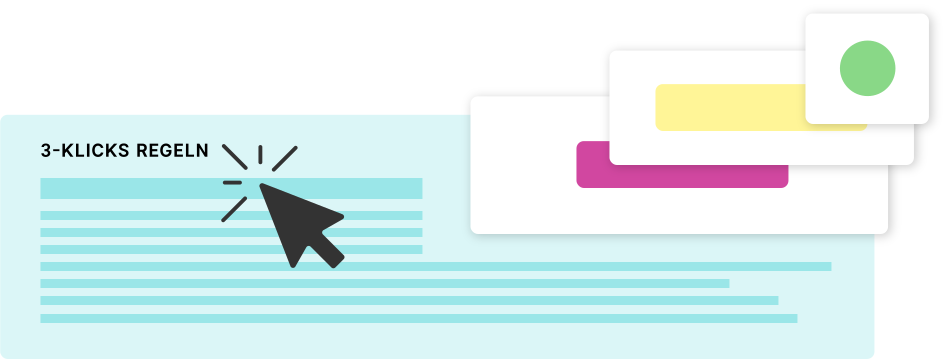
The 3-click rule is a rule of thumb that has accompanied designers for decades. It says that users should be able to reach their goal on a website in no more than three clicks, otherwise they get bored and abandon the site. According to NN Group, a leading UX research firm, there is no research or data supporting the rule. They argue that the 3-click rule is a myth, a simple guess someone coined because they simply didn't know better.
The truth is that users want to reach their goal and find what they're looking for with as little effort as possible, but three clicks is not the magic number for doing that. In fact, the number of clicks required doesn't necessarily cause frustration if it exceeds three clicks, as long as there are clear and instructive navigation options. It should therefore be clear to the user what to click and what is expected to happen. Different clicks also require different amounts of mental effort; some are easier and quicker to understand than others. It's therefore about motivation rather than number of clicks. But isn't 2 clicks better than 6 clicks for finding what you're after? Not necessarily. Fewer clicks don't necessarily feel faster or make your users happier if they instead demand greater effort.
We could compare clicks to currency where each interaction costs money. Some clicks cost 100 kr while others cost 500 kr. If I buy a pair of shoes I want to pay as little as possible; it’s not about how many bills I hand over, but about the total sum. I’d rather pay four 100‑krona bills than one 500‑krona bill
If I visit a website where it takes me 5 clicks with clearly worded links to reach my goal, each click requires only a small effort. Thus the interaction cost is relatively low. If I instead go to another site where it only takes me 3 clicks, but where each click takes longer to interpret and understand, each click requires more effort and the interaction cost therefore becomes higher. The first site will be perceived as both easier and faster to use, even if it means more clicks before I reach my goal
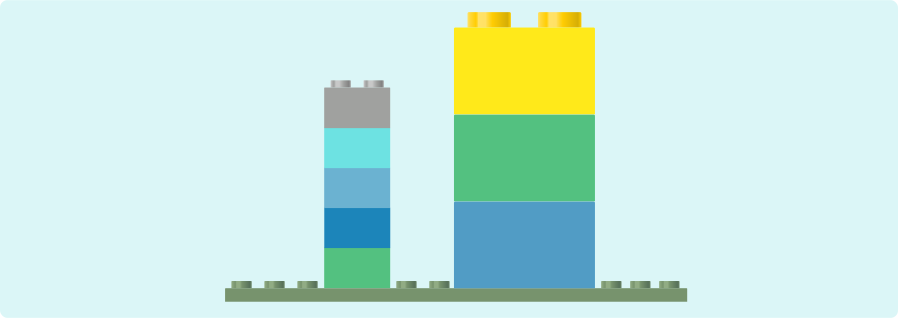
More clicks may be perceived as easier than fewer clics if they are more difficult to interpret.
Your users will therefore not automatically abandon your site if it requires more than three clicks. What matters is the total interaction cost and the overall effort. How easy is it to find, understand and click your way to the goal? If you have clearly worded links and calls to action that users understand, you’re well on your way. If the user is sufficiently interested, the number of clicks doesn’t matter as much either. You must therefore capture your visitors’ interest, but also engage and succeed in retaining that interest throughout the user journey
If the number of clicks doesn't matter as much as we thought, what then affects the user's motivation to reach the goal? What really matters is how easy it is to locate and navigate – simply finding the right thing. Some compare it to “The scent of information”, that is, the constant scent of information along the user's path to the goal.

Just as a scent can be perceived differently, information can be interpreted differently by different people. When you smell a wine, the connoisseur says it smells of chocolate, citrus and a little earthiness with a touch of coffee. Meanwhile the layperson says it smells sweet and a bit of apple. The scent that attracts the bear may not attract the hare. In other words, different information appeals to different target groups. The same information can be experienced differently depending on the current need and past experiences. A link that contains the word "Food" has a high scent value if you are looking for dinner tips, but a low scent value if you are looking for laundry detergent.


The appeal of information is therefore about capturing the user's attention. You can do that with the right words and phrasing, with the right images, a good structure and navigation that makes it easy to understand and find what they're looking for. If the user doesn't notice that they're clicking but is absorbed by the information, a few extra clicks won't make much difference. But it's important not to lose the user's focus along the way, because then there's a risk they'll start noticing the number of clicks and the effort it requires.
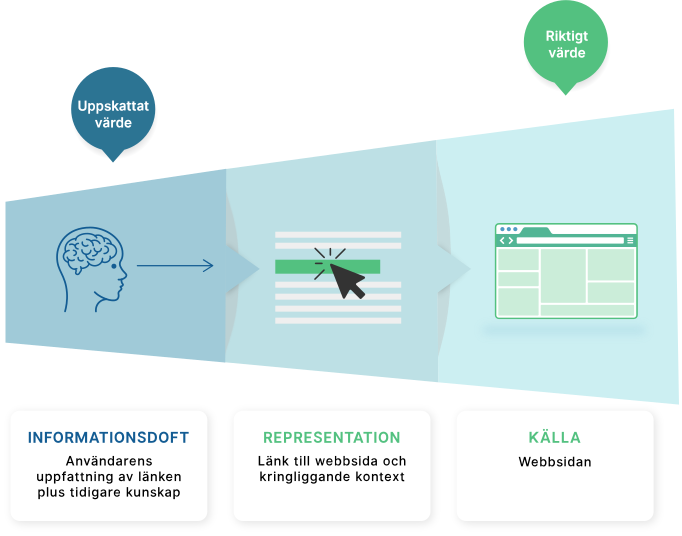
People take into account the value of what the click will deliver.
Simple and clear clicks that require little mental effort to interpret and understand are therefore good. But designing them can be easier said than done. Here we give you some concrete examples of what to keep in mind:
Use clear wording. Users should quickly understand what the click means and where it leads them. Avoid jargon or terms and labels that users don’t understand. Keep the language simple, keep link texts short and, if possible, include important keywords in the link text.
Example:

The structure and layout should match users' expectations. Each click should be perceived as bringing the user one step closer to their goal. If a user clicks the wrong thing, you should not force them to start over from the beginning.

Breadcrumbs or bride crumbs

Landing page

Divide the content into steps

Navigation on a subpage
Now you know a little more about the 3-click rule and that the magic number isn't necessarily three to get satisfied visitors. Take a moment to consider how easy or difficult it is for users to find what they're looking for on your website. Do you manage to capture visitors' interest through information scent? Do you have clearly worded links and calls-to-action that users can understand?
At Limetta, we have extensive experience designing user-friendly digital products and services. We can help you review everything from navigation and structure to content and visual identity. Contact us and tell us more about your challenges and we'll help you optimize your website and create an engaging digital experience.