Technology
Digital fingerprints - device fingerprint
We leave digital fingerprints behind as soon as we use digital devices. But what do they consist of and how are they collected?

What happens to your electronic waste and how is it recycled? How much electricity does your computer actually consume? Sustainable IT is a term that more and more people have begun to use, but few know what it means. In this article we explain what it is and what you can do to think more sustainably.
Meeting the needs of the current generation without contributing to future generations being unable to meet theirs — that is sustainability.
It is a concept that was previously marginalized in business. This has changed as, above all, combating global warming has become a pressing issue for the general public. Because companies always strive to align with what society — and ultimately their customers — consider important, the issue has been raised and become more prioritized among companies. Some companies do more than others — everyone talks about it.
Before we delve into what sustainable IT is about, we must first and foremost know what sustainability and sustainable business practices are. Sustainability often encompasses three different dimensions: environmental, social and economic sustainability. Sustainable IT is included in this. In broad terms it's about sustainable production, consumption and becoming more efficient. It's about conserving resources and reducing negative environmental impact.
The IT industry is by no means an exception. For a long time people hid behind arguments claiming that their operations did not have much environmental impact. There was no tall chimney on the roof spewing smoke, there were few physical transports and no hazardous waste generated. Today these arguments seem naive. Partly the IT sector has grown gigantic, and partly environmental work is viewed in a much more holistic way today. Just because you don't have emissions yourself doesn't mean you can be absolved if you at the same time buy goods and services from someone else who contributes to large emissions.
There are primarily two things people think about when talking about sustainable IT:
Sustainable energy consumption is about achieving more efficient energy use. This can, for example, be achieved through technical measures and through behavioral changes. To give you some concrete examples of how energy consumption works we can start with what you probably have in front of you on your desk right now — your computer.
If you only look at how much power a typical laptop consumes the figure is around 75 kWh/year. Compared with an average Swedish detached household that uses 20,000 kWh/year, 75 kilowatt-hours doesn't seem like much in context. But the truth is that's only part of the total energy consumption. If you look at how much the total use of the computer as a service consumes you must take into account more factors:
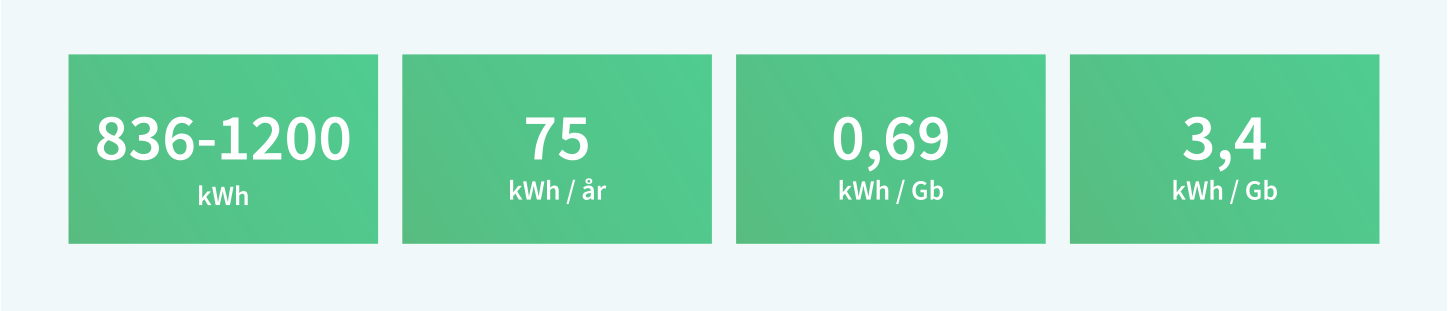
Obtaining these figures is very difficult and far from an exact science. Many of the studies that have been done are getting old and most do not deal with energy consumption at the individual level but globally or by area of use. The figures we have used here come mainly from a study called "The Megawatts behind Your Megabytes: Going from Data-Center to Desktop" carried out by The American Council for an Energy-Efficient Economy (ACEEE), 2012.
Unfortunately it is not enough to put a power meter on the cable to your computer to measure how much energy your computer usage consumes. This is because your computer is connected to a network that in turn is connected to other computers. What you do on your computer sets a lot of other computers to work, albeit remotely. Cloud solutions in turn consist of hardware that draws power and the more you use networks and cloud services, the more electricity you consume. We will look at this a bit more later.
To understand the energy consumption and make it even more concrete we can take another example.
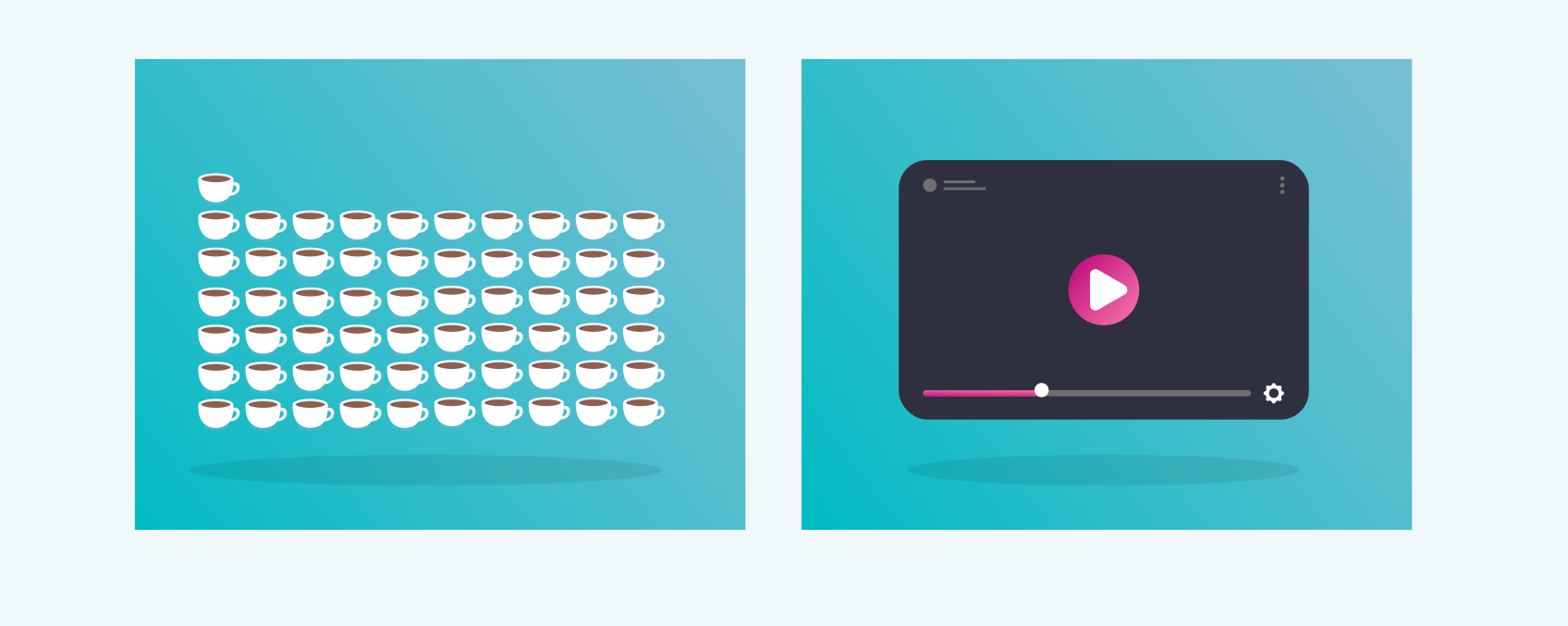
Boiling a cup of coffee uses 0.083 kWh. If you stream a film equivalent to 3 GB you will be able to boil no less than 61 cups of coffee with the same energy used to stream that film.
To arrive at this fact we used a figure from the aforementioned study which concluded that an internet transfer of 1 GB of data consumes on average 5.12 kWh. The figure takes into account the energy your computer consumes locally (38.4%), the energy required for the transfer over the network itself (13.5%) and the energy used in the data center where the film is stored and from whose servers it is streamed (48.1%). This example shows that the energy consumption for storing data in data centers accounts for the largest part. Does this mean that data centers are bad for the environment? Not necessarily.
Video streaming accounts for about 3% of the world's total energy consumption (source: Mike Hazaz, professor of human-computer integration, Uppsala University).
Producing, speculating in and trading bitcoin or other cryptocurrencies is really bad for the environment. You might find bitcoin exciting, but it’s less fun when you learn that a single bitcoin transaction consumes a little over 700 kWh and corresponds to 300 kilograms of carbon dioxide emissions.
By comparison, you could fly return from Stockholm to Paris. Or perform 750,000 ordinary card transactions for the same amount of energy as one single transaction.
The reason transactions in cryptocurrencies are so energy-intensive is that each transaction is added to a public ledger. This ensures the transaction is documented, transparent and secure, but at the same time requires storage space in the form of what are called blocks.
Each block must be computed in a process called mining. These are extremely resource-intensive calculations that globally consume every year as much energy as an entire country the size of Chile, Austria or Finland. To make matters worse, a large share of the facilities that perform the cryptocurrency computations are in China, which gets much of its energy supply from dirty coal power.
The amount of data processing carried out in large data centers increased fivefold between 2010 and 2018. At the same time, the total amount of energy these data centers consume rose by only 6% over the same period thanks to increased energy efficiency. If the same data processes had been performed on local computers or in traditional on‑premises server rooms, you would not have seen the same favorable statistics.
The conclusion is that centralized data processing in large data centers is generally a good idea for achieving efficient energy use. It is above all cooling technology that can become very efficient when operating at scale. The other two contributing factors are a high utilization of hardware through virtualization, where many applications from many different customers can run on the same physical machine, and finally that the energy efficiency of the components used in both servers and storage units has improved significantly.
Microsoft’s own calculations claim that their cloud platform Azure is up to 93% more energy efficient than equivalent on‑premises solutions
While it seems to be a good idea to perform computations and store data in large data centers, there is one problem: they hide our consumption from us as individuals. We have no idea how much the few hundred vacation photos we uploaded to iCloud will consume over time because they reside in a cloud service. Cloud services are shared with millions of other users and are often free up to a certain amount of data. In the cloud services you pay for, energy consumption is hidden in a subscription fee that of course covers the providers’ energy costs. They also do not pass our individual energy use on to us as consumers. That means we don’t think about how much energy our data storage consumes because we never see it.
It is estimated that 1.4 trillion photos will be taken globally in a year (in the 2020s). Worldwide there are a total of 8.3 trillion images stored, most in cloud services that run around the clock.
Take a look at your account in iCloud or Google Photos. If you are a typical user who saves the photos you take in the cloud you should have at least 1,000 images stored, probably more. And of course you should keep your photos! Deleting pictures of friends and family to reduce your electricity consumption would be very radical. But you should be aware that everything you store in the cloud is consuming energy around the clock because the data centers run 24/7. If you store them locally on your own hard drive, which is turned off when the computer is turned off, you don’t have the same problem. What you can do is consider whether you really need to store all ten photos of the peony in the garden from different angles?
As a consumer you usually have no idea what type of electricity a data center uses — whether it is fossil‑free or not. Both Google and Microsoft are today carbon‑neutral companies. That is not the same as saying they emit no carbon dioxide at all, nor does it mean that they use modern technology to capture and store the same amount of carbon dioxide from the atmosphere as they emit. To become carbon neutral they buy emission allowances and support projects in other operations that in turn reduce the amount of carbon dioxide emissions in the atmosphere. In this way they reduce the amount of carbon dioxide emissions into the atmosphere but not the amount of carbon dioxide.
An example of such a project could be paying a large forest owner not to cut down their forest. The argument is then that if the forest owner had cut down their forest it would have meant adding a lot of carbon dioxide to the cycle that was previously bound up in the trees, i.e. an increase in emissions. Now one instead counts on this carbon dioxide not being added to the cycle and uses the figure as a negative emission, even though it does not actually reduce the total amount of carbon dioxide in the atmosphere but only prevents it from increasing.
The tech companies are the single largest purchasers of renewable energy, with Google, AT&T, Microsoft, Facebook and Amazon ranking one to five on the list of companies that buy renewable energy.
The ranking of the three largest providers of cloud platforms based on their efforts to become climate neutral would look like this:
When planning and building new data centers, energy supply is central. You want to place them in locations where there is good access to large amounts of renewable energy. This is one of the reasons Sweden is a country where new data centers are often located. Here it is possible to supply the data centers with both cheap and renewable electricity in the form of wind power and, above all, hydropower.

If we start with your own computer it can be interesting to look at the resources that went into making it. According to Electronics TakeBack Coalition it takes 1,500 litres of water, 240 kilos of fossil fuels and 18 kilos of chemicals to build a computer. 80% of a computer's lifetime energy consumption is used during production, not when it is in use.
Every year the world generates over 50 million tonnes of electronic waste (also called "e-waste"). It consists of both smart devices such as computers and mobile phones and dumb devices such as refrigerators or toys. Although only 2.7% of the waste consists of directly toxic substances (e.g. lead, cadmium, beryllium, mercury, arsenic, dioxins and brominated flame retardants), electronic waste as a whole is classified as hazardous waste. This is because those substances are very toxic, which in turn means you cannot handle the waste in just any way.
About 17% of the world's electronic waste is recycled. By continent, Europe is leading the field and recycles 43% of its own electronic waste, while Asia recycles 12% and the USA a mere 9%.
The figures clearly show that there is room for improvement in recycling electronics. The question is why we don't recycle more?
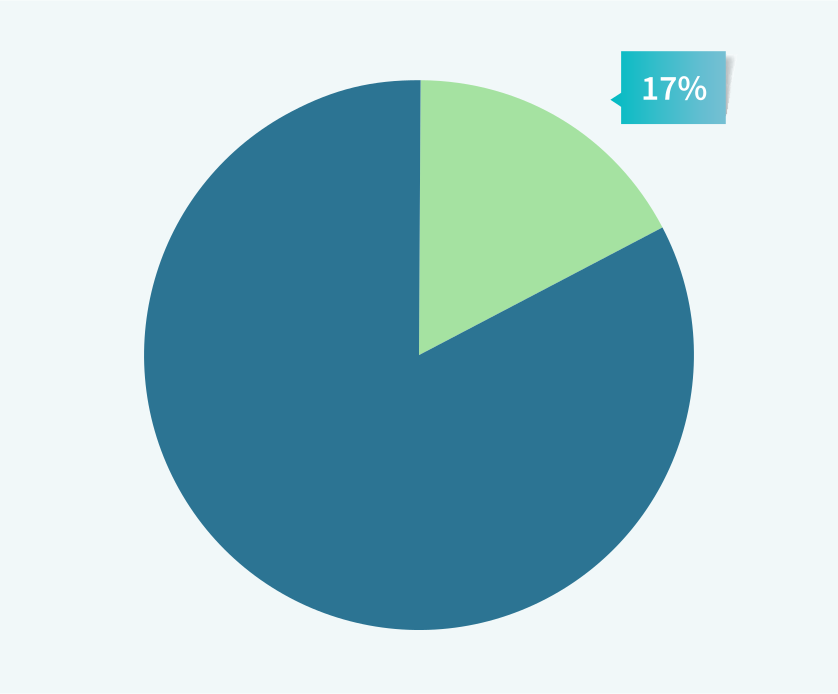
17% of the world's electronic waste is recycled
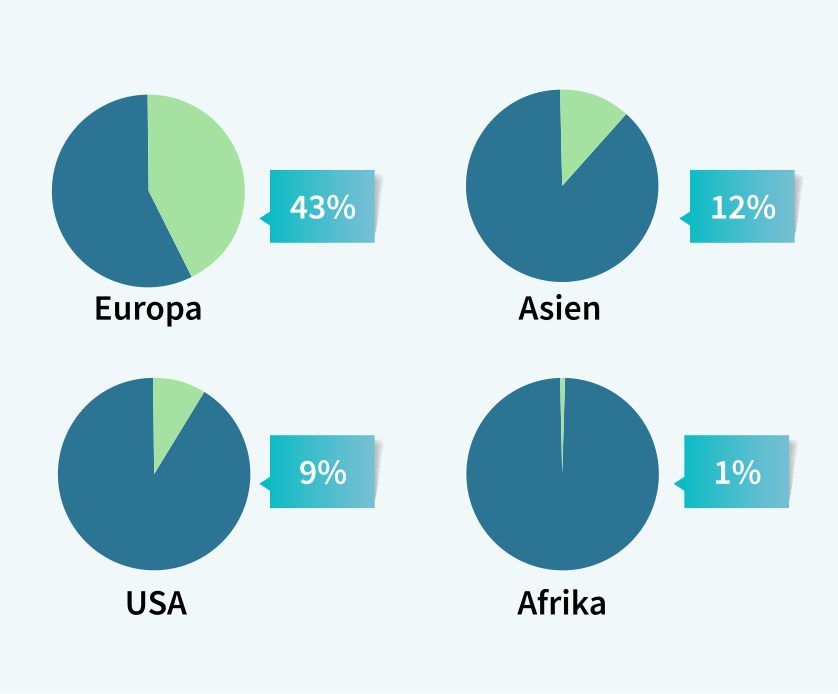
Europe recycles 43% of its own electronic waste, Asia 12%, USA 9%, Africa 1%
Recycling electronic waste in an environmentally friendly and efficient way is challenging because it consists of many different products that in turn contain many different substances. This means that e-waste is reused in slightly different ways depending on what it contains and what you want to recover. Generally, the process is that you first remove what can be removed, for example housings made of plastic or metal. What cannot be separated, such as circuit boards, is ground down into smaller pieces or a powder. Thereafter metals and other reusable substances are extracted using heat, chemical processes, magnetism and electrolysis in various steps. Exactly how the process looks depends on the raw material and what you want to get out of it. To separate precious metals such as gold, acid baths are used while iron can be separated with magnetism.
Recycling electronics is therefore a resource-intensive operation that requires a lot of energy and generates a great deal of contaminated water that then must be treated.
In the 1980s environmental requirements were tightened in the Western world and it became expensive to pollute. In response to this, "waste handlers" began to appear. These could take care of hazardous waste in the Western world and ship it to developing countries or countries in Eastern Europe. Once there they had no resources to handle it. The problem had not been solved — it had only been moved. This led to the Basel Convention, or the "Basel Convention on the Control of Transboundary Movements and the Disposal of Hazardous Wastes" as its full name. It was developed by the UN and entered into force in 1992. The countries (the parties to the convention) shall:
Unfortunately there are no sanctions for countries that violate the guidelines and the problem remains. Environmentally hazardous waste continues to be exported, often labeled as products "intended for the second-hand market" as a way to bypass controls.
The town of Guiyu in Guangdong province in China is known as the World's Electronic Graveyard. Over 100 trucks loaded with electronic scrap dump their loads there every day. 60,000 workers extract valuable metals from the scrap under hazardous conditions. Rice used to be grown in Guiyu but it no longer is because the soil and water are poisoned by all the pollution from the primitive recycling of electronic waste. The workers have no protective equipment, melt metal in woks over open fires, extract gold using open acid baths by the river and burn plastic from copper cable to expose the copper. The work is organized into 5,500 family-run businesses that handle almost 700,000 kilos of electronic waste each year. For that they get one and a half dollars a day for a working day that is 16 hours long. This is truly the dirty underside of electronics consumption. And Guiyu is not unique. The same kind of dumping sites exist in Ghana, the Philippines, Nigeria, Somalia, India, Vietnam and others.
The reason it has become like this is that it is expensive and complicated to recycle electronic waste safely in developing countries. At the same time there is plenty of extremely cheap labour in developing countries. Laws and regulations are also relatively easy to circumvent.
Finally we have landfills - simply putting the electronic waste in the dump. In the USA electronic waste makes up about 2% of the country's landfills but at the same time accounts for 70% of what is classified as toxic waste. Electronics is also the waste category that is growing the most in the USA right now.
Landfills are not a long-term solution, but handled correctly you at least have the problem under control temporarily. Provided that toxic leachate is treated and not allowed to seep into the ground.
Reuse is by far the most environmentally friendly way to handle electronic products. It is based on the fact that there is often still value in the product. The very best way to reuse is to keep and use things that still work and serve their purpose. Of course it's fun to get a new mobile phone every other year, but technological development rarely moves so fast that it's necessary. And if you are a tech nerd who wants to buy new often, you should make sure someone else can use the old phone or computer instead of just letting it sit and become even more outdated We Swedes have 15.5 million mobile phones lying unused in our drawers Some are certainly too old or broken, but many of them would be a perfect phone for someone else. Giving them away to children or relatives or selling them on Blocket or Tradera is, for example, very good from an environmental point of view.

There are also companies that specialize in reselling used electronics in the form of computers and mobile phones, or resellers who, for example, accept used phones, refurbish them and sell them on. All of this is of course much more efficient from a sustainability perspective than merely recycling the materials in the products.
There are a number of measures we can take to contribute to more sustainable IT. Some are easier than others. It may feel difficult to know where to start. The important thing is to get going – even if at first it’s only one measure. Think about how you use IT, not only privately but also at work. Here are some concrete tips:
At the workplace you can:
As a private individual you can:
We leave digital fingerprints behind as soon as we use digital devices. But what do they consist of and how are they collected?