Tips
Wireframe, design sketch or prototype
What is the difference, really?

Have you ever picked up and handled a product in a shop and then gone home and ordered it online? If so, you are not alone. As the online and offline worlds blend, we need to work in new ways to meet the customer expectations that arise from new digital opportunities. With service design we can take a holistic perspective to create user-friendly and competitive services. Here we explain how it works.
Service Design, or tjänstedesign as it is also called, can briefly be described as customer-driven business development that takes a holistic view. It is a method for developing new or improving existing services that meet customers' or users' real needs. To succeed in creating user-friendly and competitive services, you need an understanding of both the customer and the business.
Unlike UX design, which focuses on the digital customer experience, service design is more about an overarching experience where online and offline merge. With service design you therefore take a holistic approach to the customer experience and look at how people and services meet in different ways during the customer journey. A customer journey describes the path a customer takes from the moment they want to buy something until the purchase is completed and then on into the long-term use and experience of the product or service. It often winds its way through both online and offline.
Most people agree that focusing on your customers is important to remain competitive, but it is rarely simple. Digitalization and the ways we use technology have changed our behaviours. Besides attractive design, we expect everything we interact with to be fast, simple and tailored to our individual needs. Regardless of the business, you must continuously develop and improve your offering in step with new behaviours.
Take a moment and consider how your company's services fit together!
Do they work equally well whether consumed digitally or in other ways?
The purchase process for your service might start in-store but finish online. When online and offline modes merge, we must begin working in new ways to handle the demands that digitalization places on us. We also need to start thinking in new ways to meet our customers' changing expectations and needs. Companies that fail to design services and products that make customers' lives easier or that review the entire customer journey will fall behind. This is where service design comes in — as a method or approach for customer-driven business development that looks at the whole picture. Service design thus helps us develop profitable services that are anchored in customers' needs.
Your customers don't care about what suits your organization best, they just want their needs met. You therefore need to focus on the customer's needs, rather than your company's organizational structures.
Here are some quick tips:
When we at Limetta include service design in our work process, we take a broader perspective on the customer's entire business and operations.
The work is divided into three phases:
The first phase in service design is about taking stock of existing knowledge and customer insights. This can be done by running workshops with your staff where we draw on your expertise and experiences. We immerse ourselves in how your services work and the context in which they exist Through analyses, user tests, interviews or observations we get to know your customers. We look at the customer's overall experience and map customer journeys. If you deliver a service that operates across multiple channels we also need to understand how they interact. Sometimes personas are developed to represent your target groups and to guide various decisions during the course of the work.
Our combined insights give us an understanding of what your customers need and the conditions and opportunities that exist. We also gain insights into what the services must deliver to your organisation to be profitable over time. Impact goals that involve both business objectives and customer needs are defined. We simply find out where we stand and where we are going. A useful working method that we often use here is Design Thinking. The method has an outside-in approach and helps us put ourselves in the user's situation.
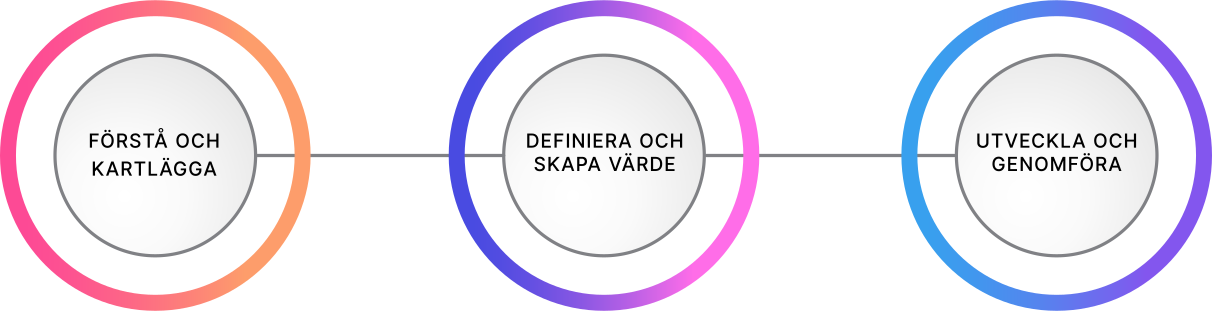
Based on customers' needs and your circumstances, we examine how we can improve the customer's experiences while at the same time create value for your business. Our ideas are visualised into concrete concepts that can consist of simple sketches, prototypes and narratives. The concept or proposed solution is the idea of how we will achieve the goals and defines the fundamental requirements. The concepts are tested and refined and then form the basis for the design work.
When we have a concept, it's time to implement. We produce concrete solutions that can be tested and implemented. The solutions can, for example, consist of a content strategy that includes interaction design and graphic design of a digital interface. It can also involve organisational development where new ways of working are to be introduced. For example, it could mean training your staff in SEO to increase visibility on Google so that your customers can find you more easily. We help our service design clients to efficiently implement and realise the solutions the project has resulted in.